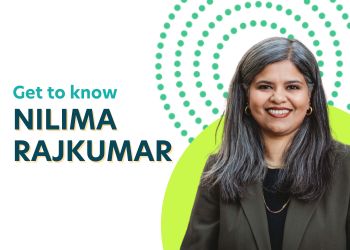
Get to know Imagine360’s new Chief Product Officer, Nilima Rajkumar, whose passion for making healthcare both accessible and affordable is driving innovation at Imagine360.
Q: How did you get into healthcare?
A: Healthcare was always part of my world. I grew up around physicians, and while I didn’t go to medical school myself, watching their commitment to patients had a lasting influence on me.
After grad school, I joined a consulting firm that at the time focused on the pharma space, which became my entry point into healthcare. I spent a lot of time talking directly with physicians, hearing their stories, and learning firsthand about the challenges they face. Those conversations made it clear how much good healthcare can do, and how much opportunity there is to make it work better for both patients and providers.
Q: What attracted you to Imagine360?
A: I’ve always believed healthcare should be accessible to everyone, but in the commercial market, rising costs have become a real barrier to care. When people are worried about affordability, it directly affects their health and their willingness to seek care in the first place.
What stands out about Imagine360 is that the company doesn’t treat cost and experience as a tradeoff. The team is tackling cost containment in a fundamentally different way, while staying deeply focused on the member experience. That combination—real cost discipline paired with thoughtful, human-centered design—is rare in this industry, and it’s exactly the kind of impact I want to help scale.
Q: From your experience across traditional health plans and health tech, what do health plans do well today—and where do employers and members still feel the gaps?
A: Most people working inside health plans are genuinely mission‑driven. They care about members and want to do the right thing, and when the system works well, individuals and organizations with the resources to navigate it can access some of the best care in the world.
The challenge is that those outcomes aren’t accessible to many people, and it is an ever increasing number. We’ve created a bifurcated system that’s often unaffordable for the average American, and even when people do get care, the experience can be confusing, opaque, and stressful.
There’s a significant opportunity for health plans to focus on making care more affordable and accessible, while simplifying the experience end‑to‑end. Reducing friction, increasing transparency, and designing around how people actually use healthcare—not how the system has always operated—would go a long way toward delivering better outcomes for both members and employers.
Q: Looking at the employer health plan market, how do you define success?
A: At its core, health benefits should feel like a benefit. To me, success is when employers believe their health plan is delivering real value for their employees and their business, not just managing risk or checking a box.
That means employees can access care without fear of unexpected costs, and employers can offer meaningful coverage without putting the business at financial risk. When a health plan supports the long‑term health of the organization and the people who make it run, that’s when it’s doing its job.
Q: What principles will guide your product strategy at Imagine360?
A: My approach is built on three pillars: making healthcare more affordable for all parties, supporting positive clinical outcomes while delivering an outstanding member experience . These will guide every product decision we make.
Q: What’s the AI opportunity for Imagine360?
A: The real value of AI comes from pairing it with high‑quality data and clear intent. As pioneers of reference‑based pricing, Imagine360 has a rich understanding of what fair, transparent healthcare pricing looks like. That creates a powerful foundation for using AI to surface better insights, anticipate issues earlier, and make the health plan experience more intuitive for all stakeholders.
We’re already applying data in meaningful ways today, but the long‑term opportunity is even bigger. As our data continues to grow and technology evolves, AI can help create a flywheel—where better insights lead to better experiences, which in turn generate better data.
Q: When employers evaluate their healthcare partners, what do you want Imagine360 to be known for?
A: “This plan saved the company more money than I thought possible and did so while delivering an experience that my employees love.” That’s exactly what I hope people say about us.
Q: You serve on the board of a Federally Qualified Health Centers. Why is health equity so important to you?
A: At a fundamental level, I believe everyone deserves access to high‑quality care. Federally Qualified Health Centers play a critical role in making that possible by serving some of the most vulnerable populations.
Serving on the board allows me to stay closely connected to the real challenges of both patients and providers. It’s a way for me to give back, while also grounding my perspective in the realities of care delivery and access gaps that exist today.
Q: How do you recharge?
A: I love reading, and lately I’ve started watercolor painting. It’s quick, relaxing, and really satisfying.
Q: What’s one thing that people would be surprised to learn about you?
A: I’ve lived on three continents! I grew up in India, spent part of my gap year in the UK, and have spent most of my life in the U.S.