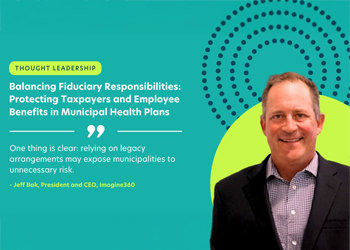
Jeff Bak
PRESIDENT AND CEO
Over the past year, serious concerns about employee health plan administration have been raised, leading to increased pressure on employers’ roles as fiduciaries.
More recently, the importance of fiduciary responsibility was emphasized for municipalities and public entities. Allegations of overcharging and inaccurate claims processing raised questions about the stewardship of taxpayer dollars and the true cost of municipal health benefits for public employees.
These issues not only jeopardize the financial health of municipalities but also undermine trust in the systems designed to support public employees.
For context, the cost of municipal health plans continues to climb, with employer contributions often exceeding those in the private sector. Recent data shows that the public sector covers a larger portion of the total premium compared to the private sector. The average employer contribution is about 87% for single coverage among state and local government workers. Comparatively, private sector employers pay 80%.
Municipalities carry a fiduciary responsibility to manage health plan resources wisely, striking the right balance between supporting employees and safeguarding taxpayer interests. Recently, several municipalities and public entities have asked me how they can approach this role with greater financial stewardship. I’d like to share that guidance more broadly for others who may find it valuable.
To safeguard public resources and restore trust in municipal employee health plans, leaders can:
- Audit out-of-network claims data and the associated carrier fees: Routinely conduct thorough reviews of all out-of-network reimbursements to identify overpayments and ensure alignment with market-based rates, such as Medicare.
- Explore alternative plan designs: Consider innovative solutions like reference-based pricing (RBP), which ties reimbursements to objective benchmarks—like Medicare—and delivers predictable, fair costs for both municipalities and employees. In fact, a recent analysis by Chris Whaley, Roslyn Murray, and the Committee for a Responsible Federal Budget found that implementing RBP within the Federal Employees Health Benefits program could save federal employees and taxpayers $90 billion over ten years.
- Review broker compensation: Evaluate all broker and consultant contracts for hidden fees, excessive commissions, and conflicts of interest. Transparent compensation structures are essential to maintaining accountability.
By taking these actions and exploring multiple avenues for oversight, municipalities and public entities can fulfill their fiduciary duty, safeguard taxpayer funds, and ensure their health plans deliver sustainable value and trust for employees and the community. We’ve seen the impact with one of our clients.
We partnered with a large school district to create a health plan focused on transparency and meaningful savings. By working with Imagine360, the district transformed its approach by adopting an alternative health plan. This shift resulted in:
- A reduction of annual health plan costs by more than 25%, allowing the district to reinvest those savings into teachers, classrooms, and community programs.
- Greater claims accuracy, eliminating overpayments to benefit employees and their families.
- Improved transparency for employees, strengthening trust and engagement in the benefits program.
This example highlights how innovative health plan strategies can deliver substantial value for public entities, municipalities, and the communities they serve.
By embracing change and considering alternative solutions like RBP, municipal leaders can restore trust, maximize resources, and ensure the long-term sustainability of their benefits programs.