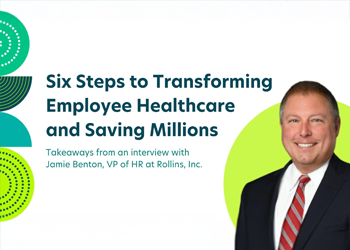
Jamie Benton, Vice President of Human Resources at Rollins, Inc., shares how he overhauled employer-sponsored healthcare, rejecting cost-shifting for employee-first benefits. By implementing reference-based pricing and offering free primary care, mental health support, and generic drugs, the company built trust and saved $29 million in five years, proving that investing in employees pays off.
- Recognized the Need for Change
For years, Rollins faced escalating health insurance premiums, which led to an unsustainable practice of shifting more and more costs onto employees. Recognizing that incremental changes were no longer enough, Rollins made a pivotal decision to fully rethink its approach to employee healthcare. By choosing to halt cost-shifting, the organization sent a clear message to its workforce: employee wellbeing and long-term sustainability would take precedence over short-term fixes.
- Adopted a New Healthcare Model Grounded in Employee Value
Rollins chose a reference-based pricing (RBP) model, departing from traditional carrier coverage. This was not a mere financial move, but one that required deep alignment among the leadership team, including HR and finance. The shift enabled the company to offer uniquely valuable benefits—such as free primary care and free generic drugs—and to reinvest the savings into further improving employee access. The new plan was designed to put employees first, enhancing their experience and confidence in the system.
- Built Employee Trust Through Tangible, Meaningful Benefits
Confidence wasn’t built overnight. Rollins focused on removing financial barriers so employees could seek medical care without anxiety over out-of-pocket costs. Free doctor visits, mental health support, and medications became accessible for all, thanks to the savings realized from the new model. Stories of positive experiences spread organically—employees shared with colleagues how they got needed care at no cost, which gradually shifted mindsets and built lasting trust throughout the organization.
- Ensured Visible, Aligned Leadership Throughout the Transition
Successful implementation hinged on leaders with credibility, resilience, and the ability to communicate the vision. Rollins ensured that executives were not only aligned on the goals but also available to personally address employee concerns, such as billing questions. This hands-on leadership established a culture of transparency and stability, proving to employees that commitment to their wellbeing was more than just rhetoric—it was a central organizational value.
- Partnered for Simplicity, Support, and Seamless Experience
After trying a fragmented vendor model with unsatisfactory results, Rollins selected Imagine360 as a partner to consolidate all aspects of benefits, billing, and advocacy under one roof. This eliminated confusion, finger-pointing, and inconvenient handoffs. With only three benefits managers supporting 20,000 employees, efficiency was critical; Imagine360 provided immediate support when issues arose, fundamentally improving the employee and administrator experience.
- Expanded Access and Broadened the Focus to Holistic Wellbeing
Understanding that most employees were geographically dispersed and not close to physical clinics, Rollins leaned into virtual care—an adaptation accelerated by the pandemic and now fully integrated into its culture. The company is expanding its health centers in key states and prioritizing free primary care to remove financial obstacles. Beyond healthcare, Rollins is using plan savings to address broader financial wellness, supporting employees in budgeting, saving, and planning—empowering them to remain focused, engaged, and able to thrive in the face of economic uncertainty.
Read more of Jamie’s interview about employer-sponsored healthcare here.